
The Hadley Legacy &
The Evolution of The Hadley Center
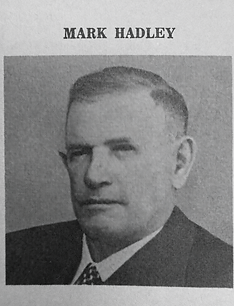
The story began in the late 1800s when Sarah Hadley, a widowed mother, brought her six children—Lily, Charles Marcus (Mark), Kitty Ethel (Dolly), Frank, Henry Clay, and Harriett (Hattie)—from Illinois to Ellis County. The family homesteaded 1,200 acres of land on the Saline River north of Hays. The property comprised mostly pastureland, which proved suitable for cattle but not for farming. Initially, the Hadleys built sod shanties on the homestead land, later building a small cottage that eventually developed into a more modern, seven-room bungalow. The family endured many early challenges on the plains, including severe droughts, blizzards, and grasshopper plagues.
Tragedy struck the family in 1894 when Mark’s mother, Sarah, and his sisters, Hattie and Lily, attempted to cross the Saline River to attend Sunday school. Their wagon was overcome by the swollen river and tipped over, throwing all three into the water. Sarah and Hattie drowned, but Lily floated downstream until she was eventually saved.
As the decades passed, the family structure shifted. Brothers Henry Clay and Frank left the ranch and never returned; both died at an early age, in 1929 and 1930 respectively. Meanwhile, Mark and his sisters, Dolly and Lily, continued to live on and operate the ranch.
Parallel to the family’s journey, local healthcare was also evolving. In 1922, a new medical facility opened its doors as the Hays Methodist Episcopal Hospital, later becoming the Hays Protestant Hospital in 1925.
By the 1930s, the Hadley family’s fortunes completely reversed, altering the destiny of Hays forever. Oil was discovered on their rugged property, forming what became known as the "Bemis Oil Pool"—the largest oil pool in the state of Kansas. Fortunately, unlike many neighboring farmers along the Saline River, the Hadley family had kept the mineral rights under their land. Following the passing of Lily and their other siblings, Mark and Dolly Hadley became the sole owners of the massive estate. Despite their immense wealth, the brother and sister continued to live frugal lives, choosing instead to channel their oil revenue back into the community through healthcare.
.png)
The scale of their wealth during this era was staggering. In a 1945 Kansas City Star article, Mark was quoted as saying, “The ranch had 53 producing oil wells, all of which could produce between 300 and 600 barrels of oil per day.” Under his management, the family acquired additional land, expanding the ranch to 2,720 acres and maintaining a cattle herd of 400 to 500 head. Mark openly stated that the oil and cattle industries did not mix well, and noted that if he had to choose, he would choose cattle. He deeply preferred the hard work of cattle ranching to the administration of oil ownership. This unique mindset directly fueled his desire to gift his oil wealth to the local hospital.
In 1941, after the local hospital finally cleared its Great Depression-era debts, the facility launched a major expansion heavily financed by the Hadley family. To honor Mark and Dolly's transformational contributions, the facility was officially incorporated as Hadley Memorial Hospital in 1942. Sadly, Dolly preceded Mark in death in the mid-1940s, leaving Mark as the sole remaining family member.
In 1949, Mark committed to funding yet another major hospital expansion, but he unexpectedly passed away from a heart attack before it was completed. While the estate endured brief initial legal battles, a clear path was eventually forged for the estate's steady oil royalties to finish the construction by 1952.
.png)
.png)
.png)
.png)
With continuous oil revenue flowing from the Mark Hadley estate, the hospital trustees decided to build something truly revolutionary. Utilizing funding from the federal Hill-Burton Act of 1956, they constructed a massive, cutting-edge facility. Dedicated in May 1959, it became the very first rural comprehensive rehabilitation center in the entire United States, specializing in chronic illnesses, physical rehabilitation, and psychiatric care.
Again in 1972, revenue from the Hadley Ranch helped finance a sweeping expansion and renovation. Completed in 1975, this project added an expanded east wing, a new chapel, a medical unit, an obstetrics and nursery unit, an education center, and mental health offices.
For decades, the facility served as a vital regional lifeline, eventually evolving into the Hadley Regional Medical Center. In 1991, it officially merged with its longtime local counterpart, St. Anthony Hospital, to form what is now HaysMed.
The building's expansion and adaptation continue to this day. For instance, the third-floor east wing recently underwent a comprehensive structural renovation to bring a state-of-the-art Hays Crisis Intervention Center to downtown Hays. For over a century, the Hadley legacy has been defined by community impact. By continually transforming historic infrastructure into a modern hub for innovation and business, The Hadley Center ensures that its story will endure, changing gracefully to serve the needs of the next generation.
Sources -
Campbell, Marc T., Jr. A History of Hadley Memorial Hospital and Rehabilitation Center. 1962. Fort Hays Kansas State College, Master's thesis. FHSU Scholars Repository scholars.fhsu.edu/theses/734/.
HaysMed Foundation. "The Hadley Foundation: Ellis County Legacy." HaysMed Foundation, haysmedfoundation.org/hadley-rooms-receive-upgrades/.
Following the 1991 merger and the eventual relocation of acute clinical beds to a unified medical campus by 2000, the massive structure was carefully repurposed into The Hadley Center office complex. While the iconic mid-century exterior was masterfully preserved, the interior layout underwent major updates. The space was divided into premium, customizable commercial floor plans featuring high-speed data networking, localized corporate zoning, a modern restaurant layout, and specialized tenant spaces.

.png)
Hadley Memorial Hospital circa 1960's